


Early, gloomy morning in Suomenlinna: we are rushing towards the ferry to make it to our Onnibus (onni means luck in Finnish) heading towards Äänekoski in an hour. Soon we realise that one of us left our phone at home; oh well, maybe not so lucky this time. At least we have one phone with us to save us from getting lost and not having documented proof of our visit. As we are finding our way to the bus stop, buried underneath the Kamppi shopping mall (which we recently discovered is architect Juhani Pallasmaa’s project), we take some brief moments to observe the inclined columns, and snap a few pictures. A 5-hour journey lies ahead of us and we will reach central Finland, the part of the country where one of the most intense logging processes takes place.
Today, as material chains are becoming increasingly difficult to trace, turning into complex chains of human and nonhuman actors that form assemblages and hyperobjects and entangle the globe, most users of the final product have no idea what environment it comes from. “If you think about more traditional means of production, there was often a closer relationship between the place where materials were extracted and where they were processed. With the rise of industrial production, these relationships got lost.”[1] These environments of production are now moved far from residents’ eyes, and even when one tries to reach them, they are well protected, automated, and secured, to the point where even the workers of the facility might not have seen the insides of the infrastructural entity. Visiting Äänekoski would let us come closer to one well hidden infrastructural body; an environment where wood products come from.
The area around Äänekoski, where we are heading, is heavily forested, and defined by the fractured Lake Keitele, which stretches in the southwest-northeast direction. There are 170 lakes in Äänekoski, and 13 Natura 2000 protected areas. The town is a major industrial center, and the forest, pulp and paper industry a main employer here. In 1891, a groundwood pulp mill and a cardboard factory was founded. Today it is one of Europe's biggest bioproduct mills, run by Finnish wood industry giant Metsä Group, producing softwood and birch pulp as its main products, alongside sawn timber, crude tall oil and turpentine, bioenergy, product gas, sulphuric acid, biopellets and biogas. The mill employs some 2,500 people in the direct value chain.
Onnibus happily rides through an ever greener and more hilly landscape as we move up north from Helsinki. Getting closer to Äänekoski, some industrial landscapes appear – we pass by Rauhalahti power plant, standing right by the road, so it is possible for us to examine the structures and some materials, like piles of wood chips, ready to be used as biofuel, closer. This power plant used to serve energy for Kangas paper mill, a project by architect Alvar Aalto, that was located near the center of Jyväskylä and operated for 136 years, until 2010. Later, parts of it were demolished and now a new residential district is being developed on the grounds of a former paper mill.
Not long after passing Jyväskylä, the bus drops us at an empty roundabout in the middle of nowhere. It is quite a stretch to walk to Äänekoski from the road, so we wait for the pre-arranged local taxi to arrive. Soon, a whole minibus appears, which is apparently our taxi, and we step inside. The spacious taxi drives the two of us straight to the factory – Äänekoski Bioproduct Mill. As we get closer, we try to catch some glimpses of the industrial body from afar, but with no luck: from the road nothing is visible; the view of the factory is covered by woods.
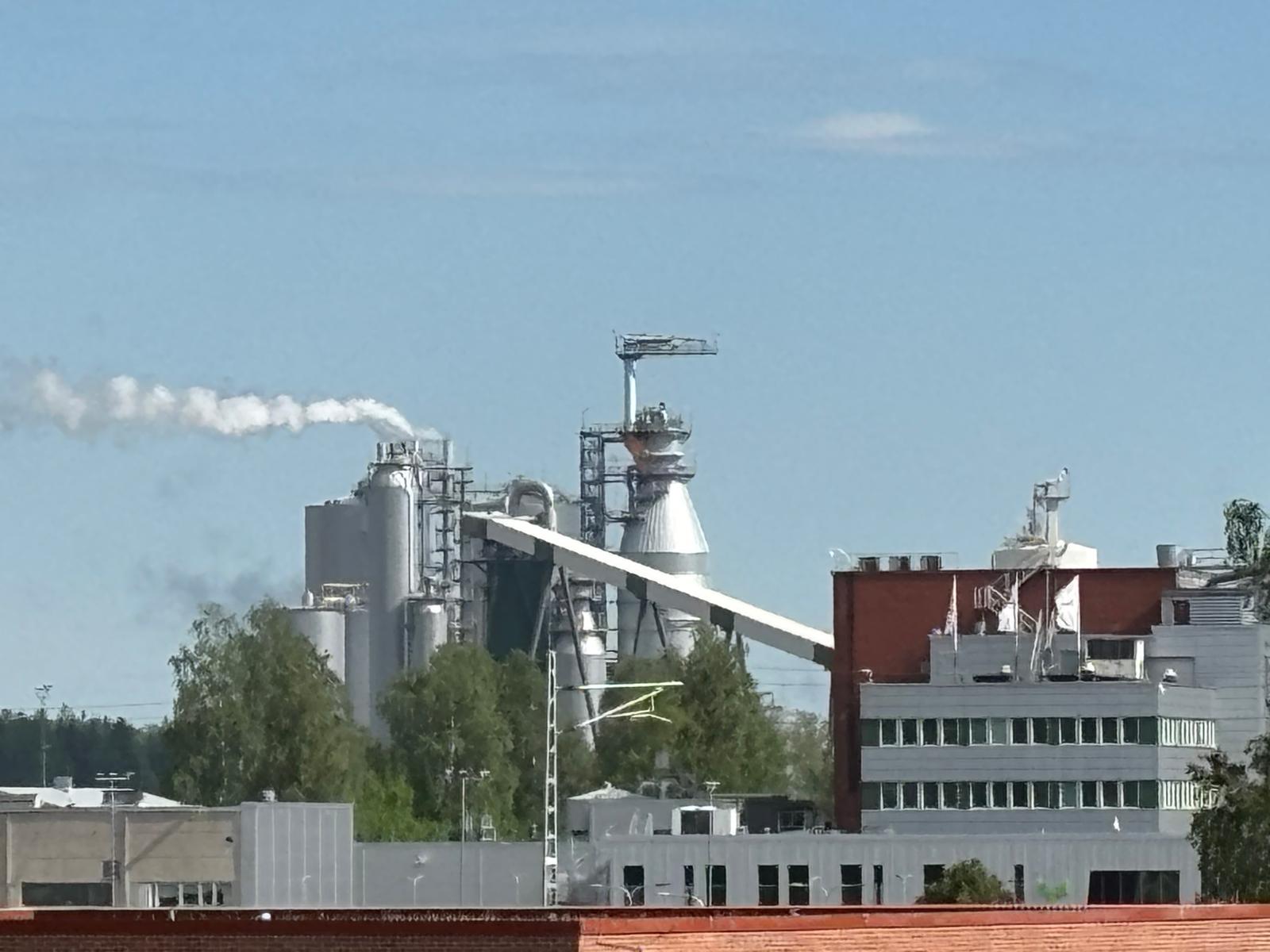 Äänekoski Bioproduct Mill
The factory area is almost the size of the town, split by a narrow passage of water, enveloped by the woods, its chimneys looming above. There is something eerie about the place, as if it is some kind of a Finnish analogy of Twin Peaks, with Packard sawmill and electricity as intermediaries for something wicked. All of a sudden, after riding through the woods, we pop up by the factory gate. For a moment we are confused if we should step out, but the gate opens and the car drives to the factory area. We still can not grasp the vastness of the facility, only some fragments. Huge silos and chimneys appear, and numerous lines of lifted pipes swirl above. The taxi takes us all the way to the visitors center door (apparently, this is the only taxi in town that has a permission to go inside the mill's territory). Two people are already waiting outside, and we are guided to the entrance and instructed not to take any pictures without permission.
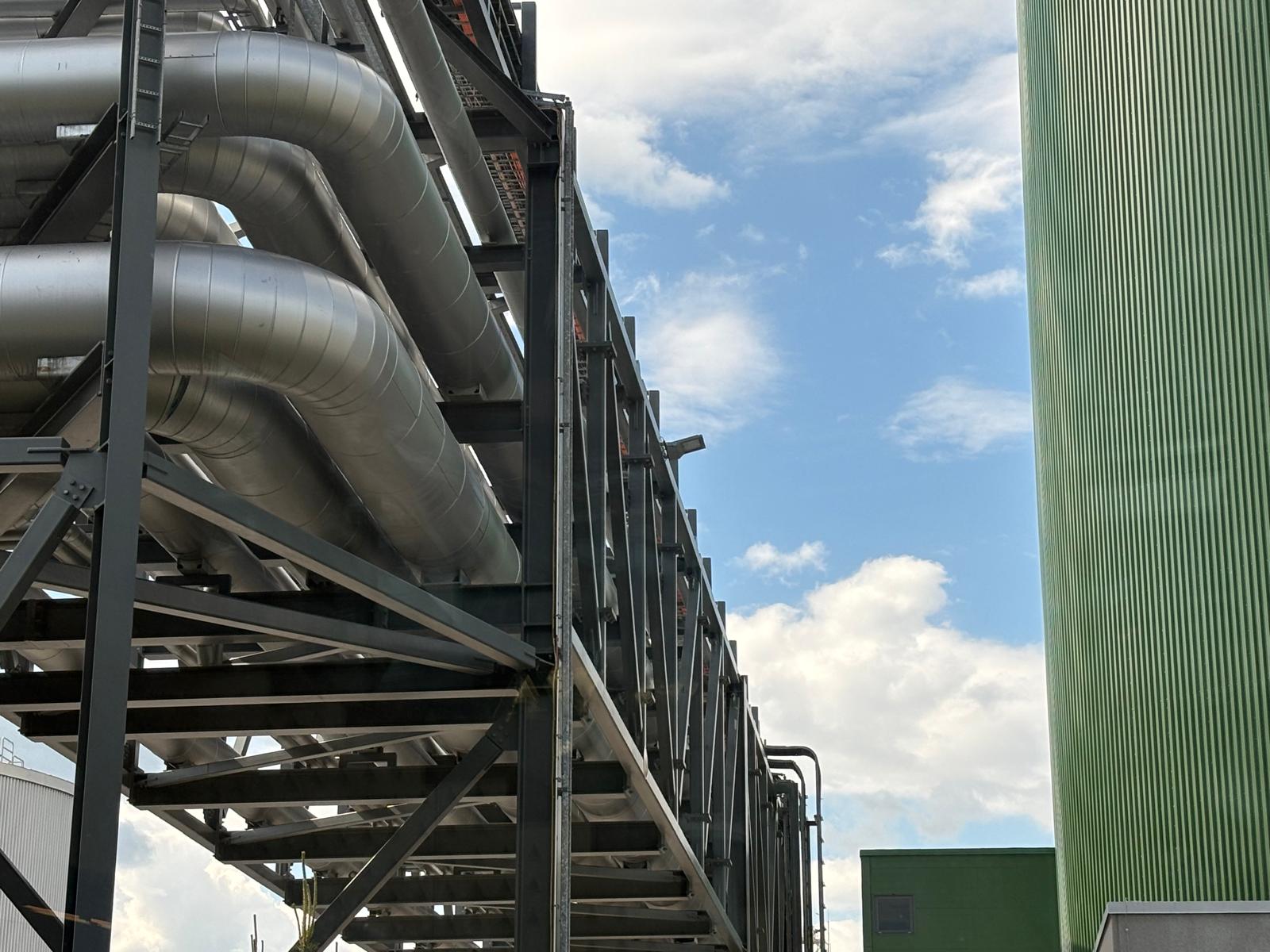 View from the inside of the Äänekoski Bioproduct Mill
“To work with wood means not only to follow the grain of the wood as it is being planed, but also to follow the way into the wood where the right kind of wood for a chosen project is to be found. Following the material and acknowledging its flows, means wandering, ambulating and mapping our itineraries.”[2] The overwhelmingly complex and large metallic organism of the factory peels, chews, swallows, digests and ejects the remnants of the tree; “nothing is left unused”[3]. Huge power forces wood to obey and turn into mountains of dust, to boil and squeeze out the elements of the former tree on cellular level. There is no following of the grain of the wood.
In such a structure, human made machines are so high up in the hierarchy, that it completely defies wood matter as a force with its own agency, and treats it as passive, inert “stuff”. Log Lady, a Twin Peaks character, who appears from time to time with an important message from her Ponderosa pine log, that she always carries around, forms a single relational unit with the matter. The log holds secrets, witnesses events and transmisses messages through its beholder. Even though the Log Lady is seen as an outcast, she is the one who truly connects the town with the forest as a spiritual entity, in contrast to the extractive nature of the Packard sawmill, which portrays a technological advancement that is causing the tearing of the cosmic fabric.[4] Who is the Log Lady of Äänekoski?
Inside the visitor center, a contrastingly warm, clean, wood cladded space takes us in. The door is locked behind us. Conveniently we get to hang our clothes and leave our bags. The restroom has wood composite sinks. We are guided into a conference hall full of chairs and welcomed to pick our seats. Seated in the empty conference room we look at a huge screen with a presentation about the factory being delivered to us personally, which feels exclusively special. We see perfectly prepared slides with a lot of green color, telling all about how great the factory is, how sustainable the company is; concerned about biodiversity and replanting, as well as circularity. We hear the numbers representing how efficient the production cycles are here – 6.5 million m3 of wood per year, 1.3 million tones of pulp, 0 percent fossil fuels, 240 percent electricity self-sufficiency rate, 69% of production is exported, fully automated LVL facility, fully closed circle. All the gasses are collected, there is no smell.
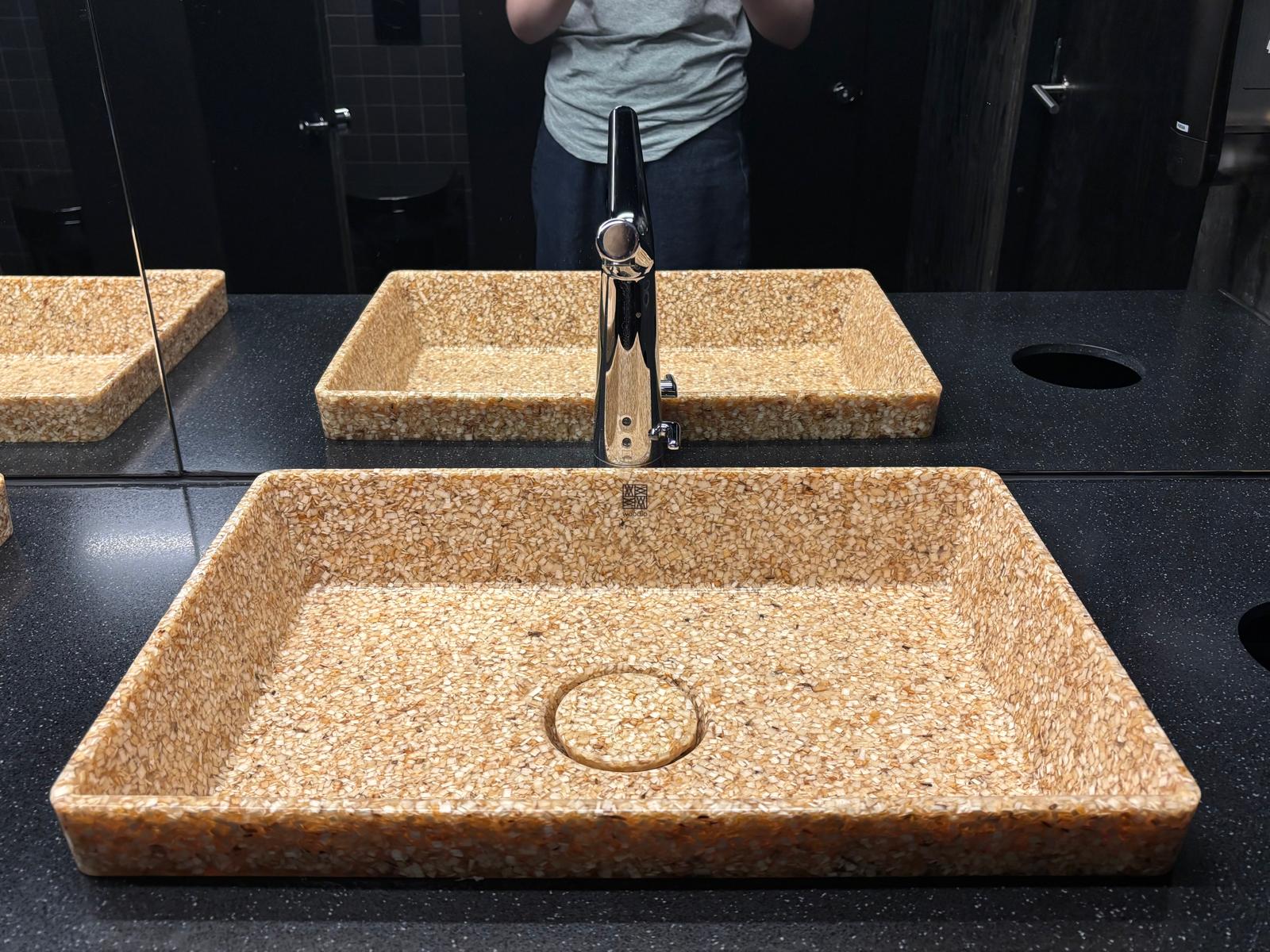 Wood composite sinks from the visitor center
“Have you ever seen the insides of the facilities where the pulp is being produced?”, we curiously asked our host. “No, and because most processes are automated, almost no one enters them.” After hearing the presentation, we can immerse ourselves in an interactive exposition that tells us what is produced at the factory, how it is produced, and about its history. We can also see the raw materials as well as the products made out of them. On the walls there are hanging wood composite boards, cardboard packaging, hand and toilet paper samples: these products are made from the raw materials like pulp or wood chips. We get two boards of pressed pulp sheets directly from the facility. On the ground floor – a surprise awaits – we learn how to fell a tree with a tree cutting machine (used by the factory workers, each cutting 800 trees per day, we are told) simulator. Lastly, we are encouraged to enter the photo booth and get one more surprise: a portrait of each with trees and wood composite boards growing out of our heads.
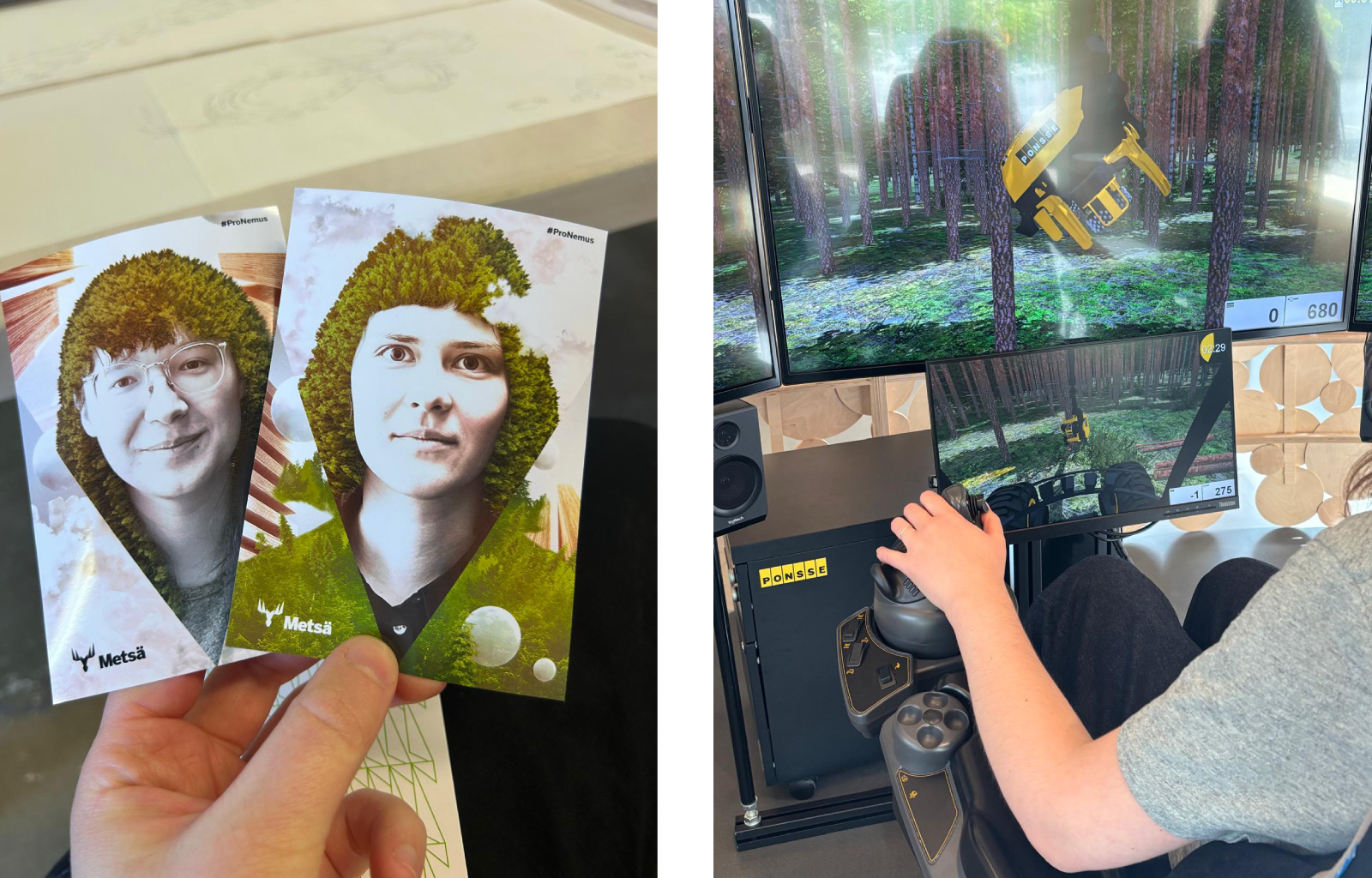 Surprise portraits, Tree cutting simulator
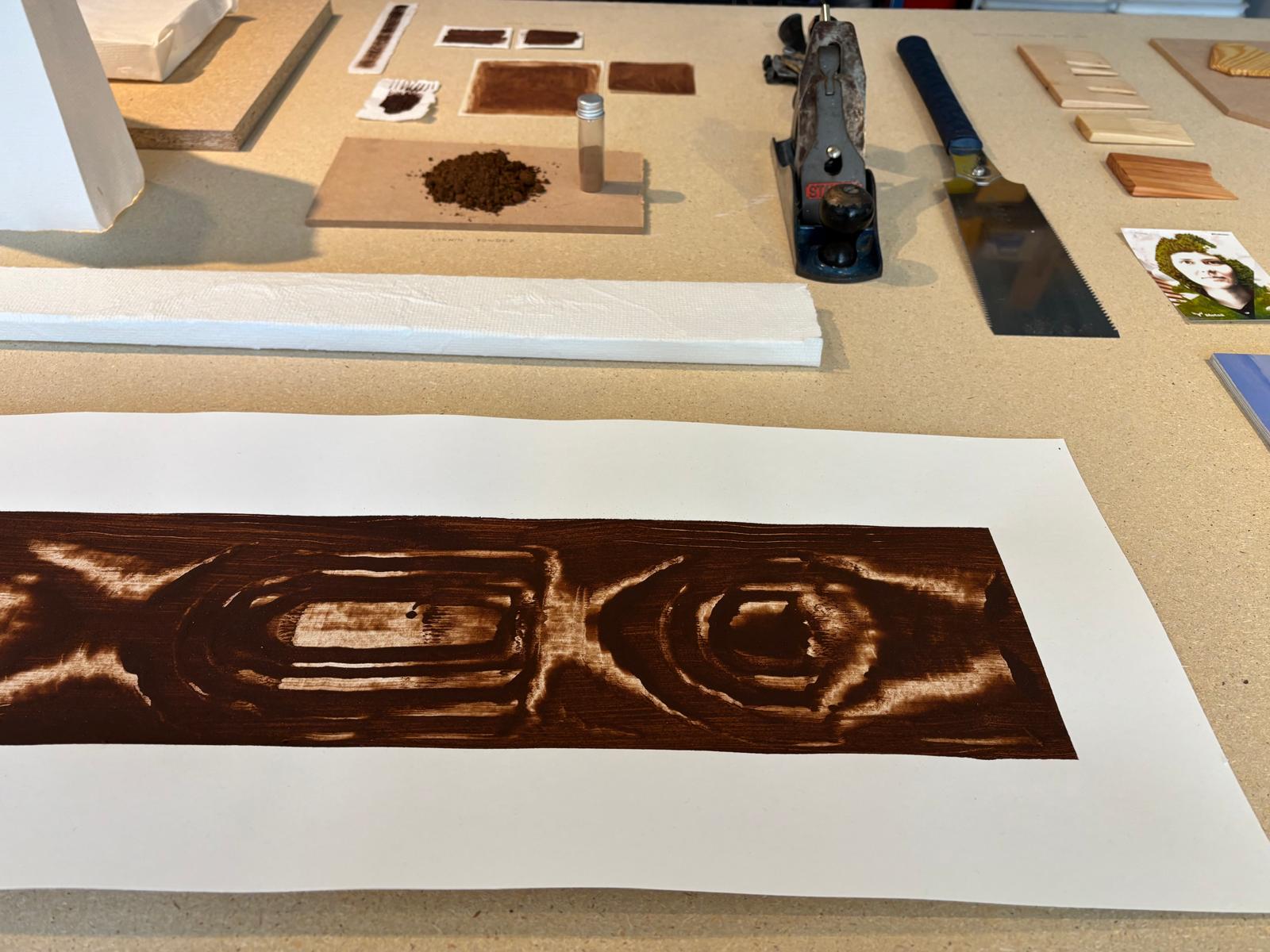
One raw material that we were particularly interested in we see (and smell!) at the factory for the first time – lignin, which is a natural wood binder found in a plant cell wall. Kraft lignin is a by-product of the pulp industry, chemically extracted after boiling wood chips with sodium hydroxide and sodium sulfide. After the boiling, a liquid called black liquor comes out, out of which the lignin powder is extracted.Usually it is used as fuel to generate bioenergy. This mill also experiments with using lignin as a concrete binder. Lignin is our focus, as it is now being introduced as a possible replacement of synthetic glues in wood composite boards, but also as a replacement of plastics. Research on lignin has been ongoing since the 1960s, yet its products struggle to get into the mainstream market because of expensive extraction. For now, there are hardly any facilities in Europe that would extract lignin for other use than bioenergy, therefore, for example Finnish companies using lignin glue for wood boards ship it from the US. These particularities of extraction and logistics of lignin are interesting for us to follow while also getting to know the material through practical hands-on experiments.
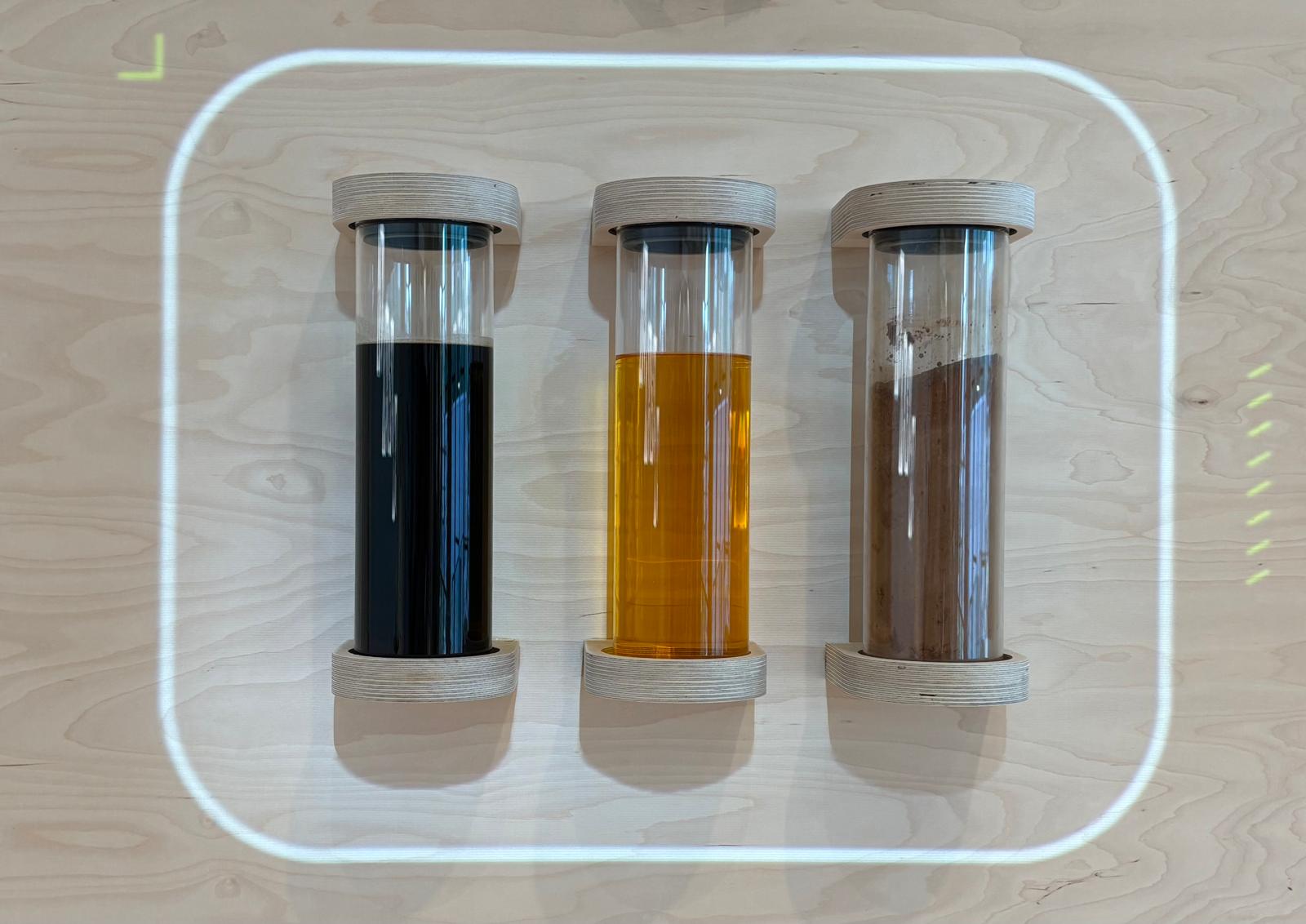 Visitor center exposition: Tall oil, turpentine and kraft lignin samples
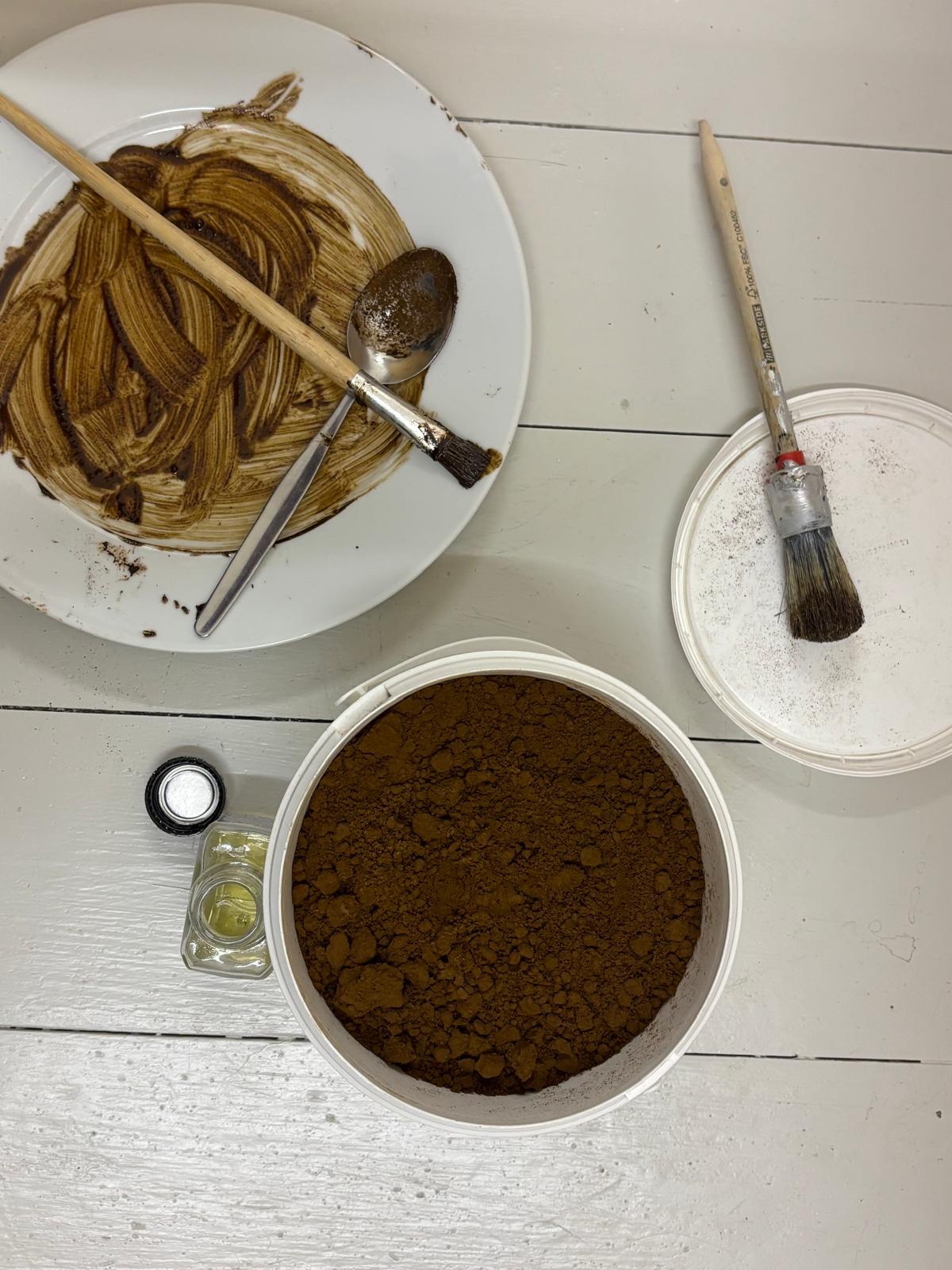 Hands-on experiments with kraft lignin at HIAP residency
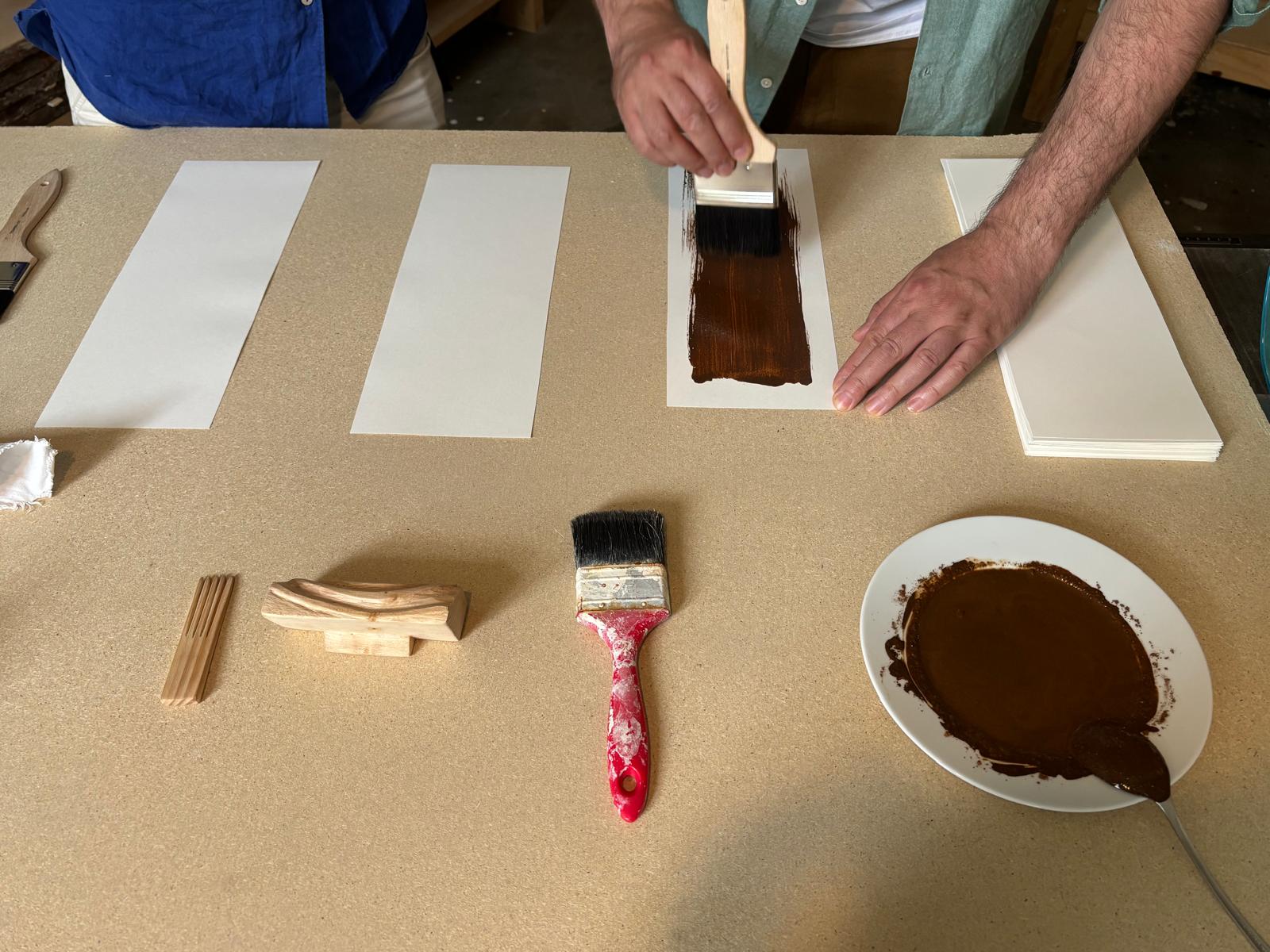 Hands-on experiments with kraft lignin at HIAP residency
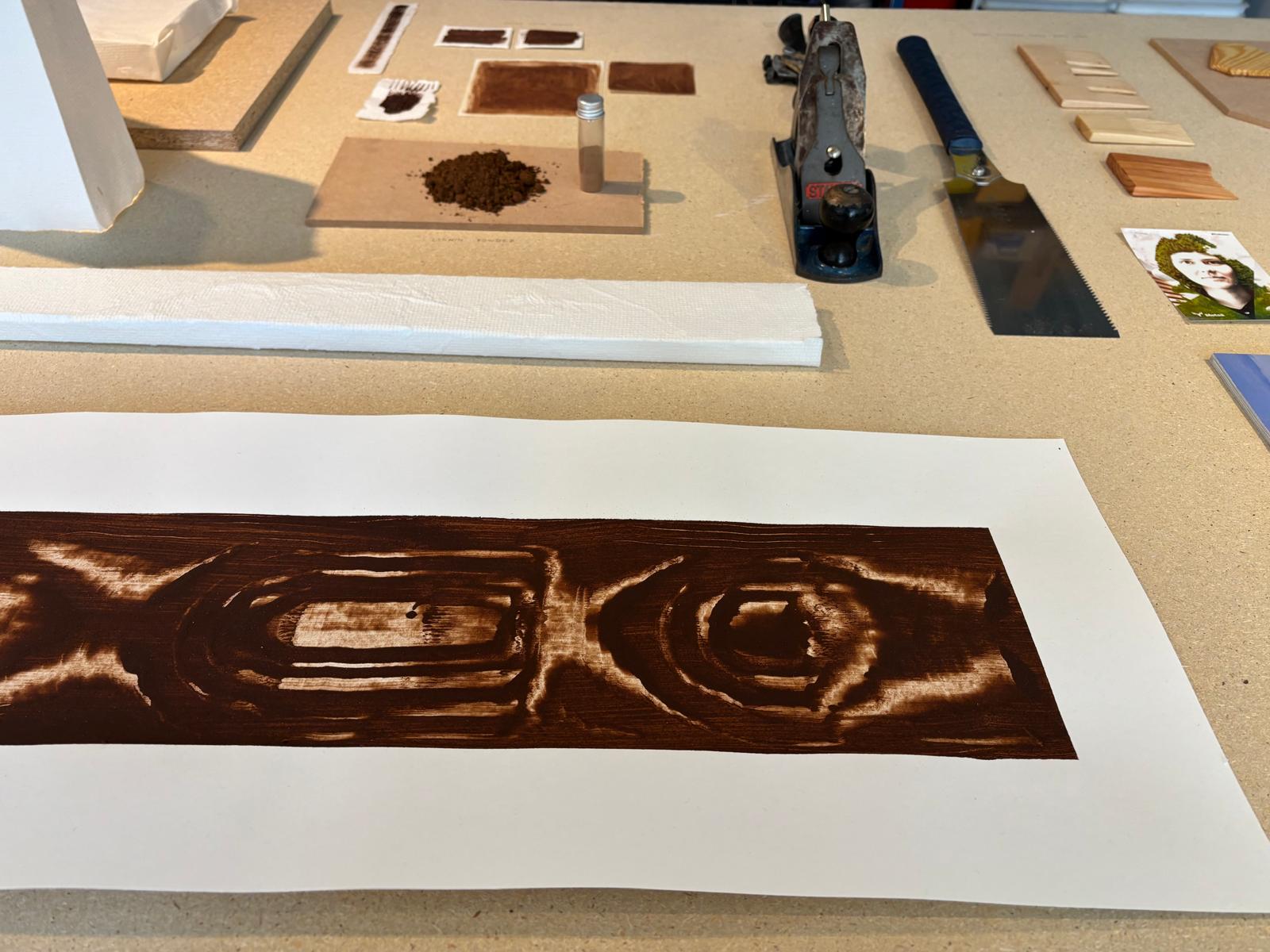 Hands-on experiments with kraft lignin at HIAP residency
After visiting the whole exposition, we say goodbye to our host, take a few pictures (with permission) and decide to take a 20 minute walk to the Äänekoski center. Many trucks fully loaded with wood logs pass by us as well as the ones intended to carry gas. We notice a big change in the smell outside, reminding of the landfill “there is no smell” we remember hearing inside. For some time we try to breathe through our mouths and cover our faces with a scarf. In a while we reach the city center, but the smell has not improved; we are still covering our faces, meanwhile locals are casually passing by and continuing their day as usual.
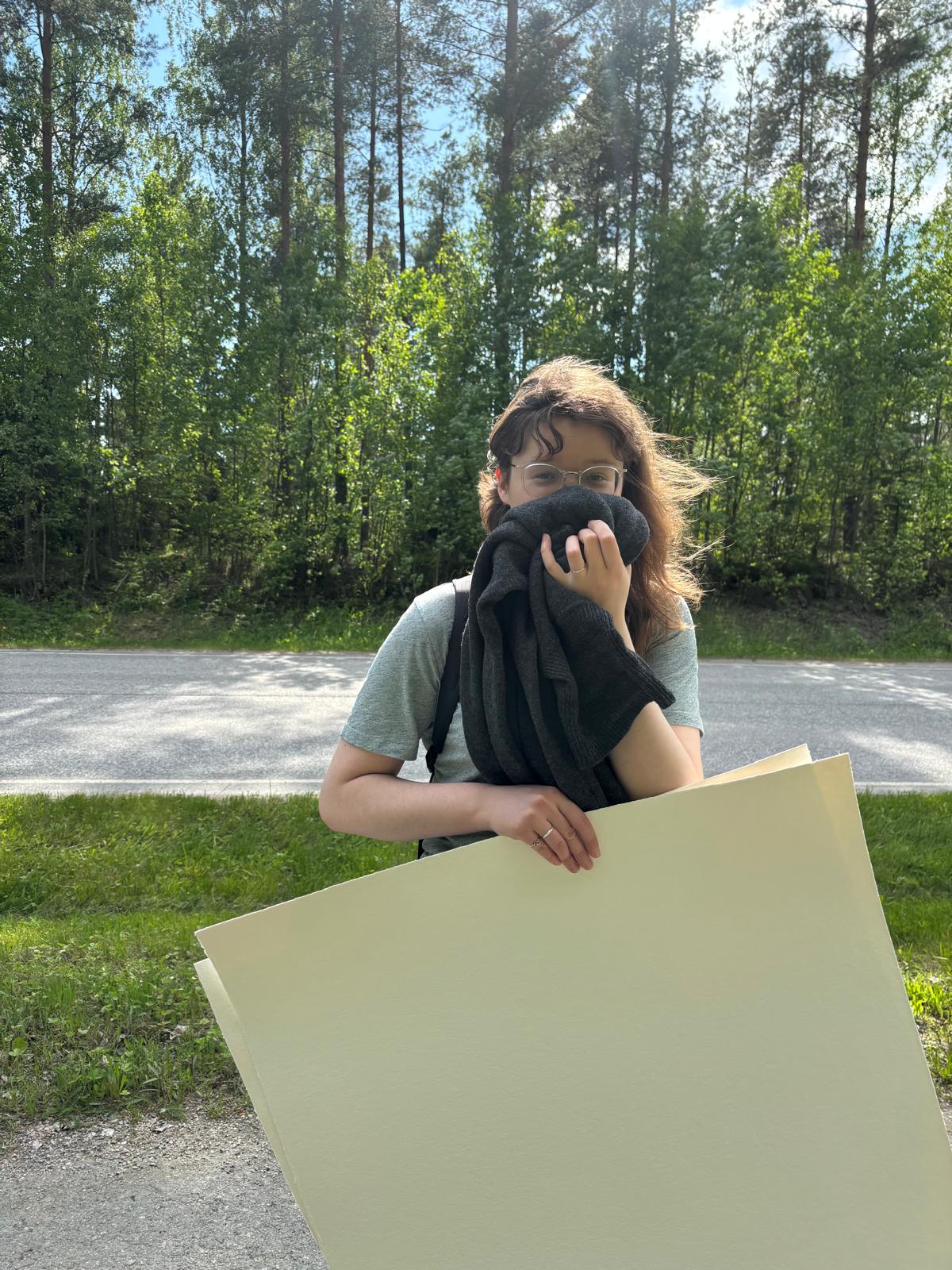 Leaving Äänekoski Bioproduct Mill with pulp sheets, encountering unpleasant smell from the factory
After a late lunch with other town visitors, who are surprised by all the generosity and food selection at the local sushi buffet, we get stuck in the rain. The only way to reach the bus stop without getting fully soaked is to again take the taxi, which we call shortly. “Is there always this strong smell around, in the city?” we ask the driver, who is a local. “No, it is only because of the summer holiday. They are working more before closing down. 30 years ago, yes, the smell was everyday. But now it’s much better. Every time they are closing or opening the smell comes.” He explains: “It is very good for Äänekoski that the factory is here. Because the factories elsewhere are closing down, it is very good that the mill here is expanding and that this place is important for the mill.”
The driver drops us out in the same roundabout we arrived at earlier that day. We are waiting but the bus doesn’t arrive on time. In the meantime, we are starting to notice a pattern – every 5 to 10 minutes a truck, fully loaded with logs, passes by. Walking beside the road we discover multiple wood chips and pieces of tree bark, dropped from the loaded trucks. The whole town is entangled and covered in the sawmill cycles and its traces are everywhere. In the visitor center earlier they mentioned that the mill is organising traffic lessons for local students. As the truck traffic is so heavy, everyone has to adapt and learn how to safely coexist with such intensities.
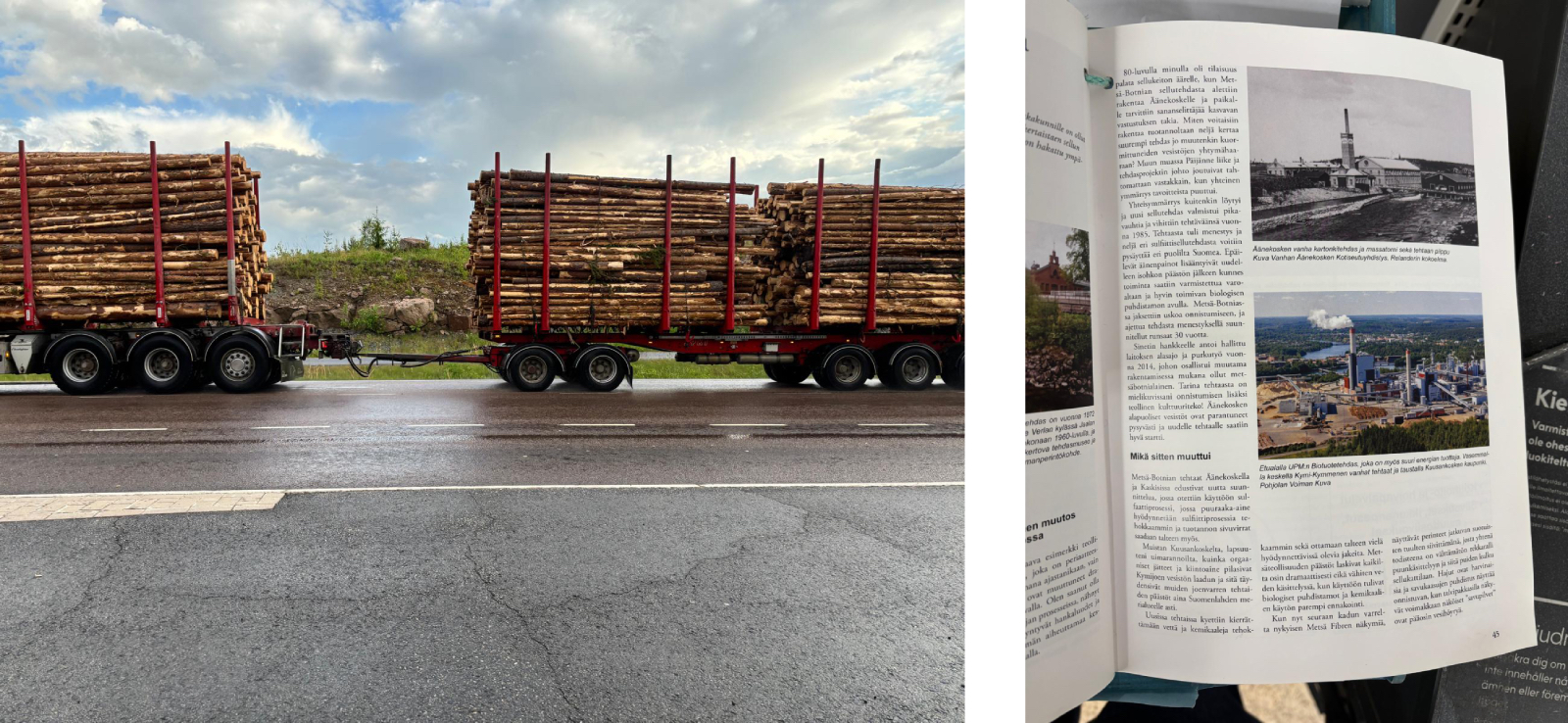 Trucks bringing wood logs to the Äänekoski Bioproduct Mill, Local newspaper at K-Market
Onnibus finally arrives and we hop inside, fitting in two sheets of pulp from the mill, a 5 hour journey back to Helsinki awaits. As we are moving further from Äänekoski, the last bits of the sawmill are vanishing beneath the cover of the trees. A secret hidden neverending cycle of turning wood to dust stays behind.
–––
Aistė Gaidilionytė and Kamilė Vasiliauskaitė are a creative duo currently based in Vilnius, Lithuania. With a background in architecture, they are interested in the role of the architect as an activist and mediator. Their practice, based on new materialism, post-growth, and feminist spatial theories, is concerned with reclaiming material expertise and emphasises sensitive observation, research, and reuse of materials, as well as hands-on prototyping, particularly focusing on investigating and rethinking contemporary building materials.
They participated in the Learning Materials pilot residency in 2026 realised in collaboration between Bioart Society, HIAP, Koynẽ Program, SWAMP: Art Material Swap and Waste Management Point and TUO TUO, and funded by Nordic Culture Point.
Sources:
1 Simone Farresin, Formafantasma, Beyond anthropocentric thinking, Bert De Roo, Giliam Ganzevles, Mirte van Aalst, Glenn Deliège, Decentring Design - Practice in a More-than-human World, Art Paper Editions & the authors, Belgium, 2024, p. 187.
2 Helene Frichot, How to make yourself a Feminist Design Power Tool, Spurbuchverlag, Germany, 2016, p. 133.
3 Fibre, Metsa Fiber Customer Magazine, Finland, 2025.
4 Basje Boer, Ode to the Log Lady, MacGuffin The Life of Things, No 12, The Log, The Netherlands, 2023.