


19 — 30 Oct 2026
Location: SOLU
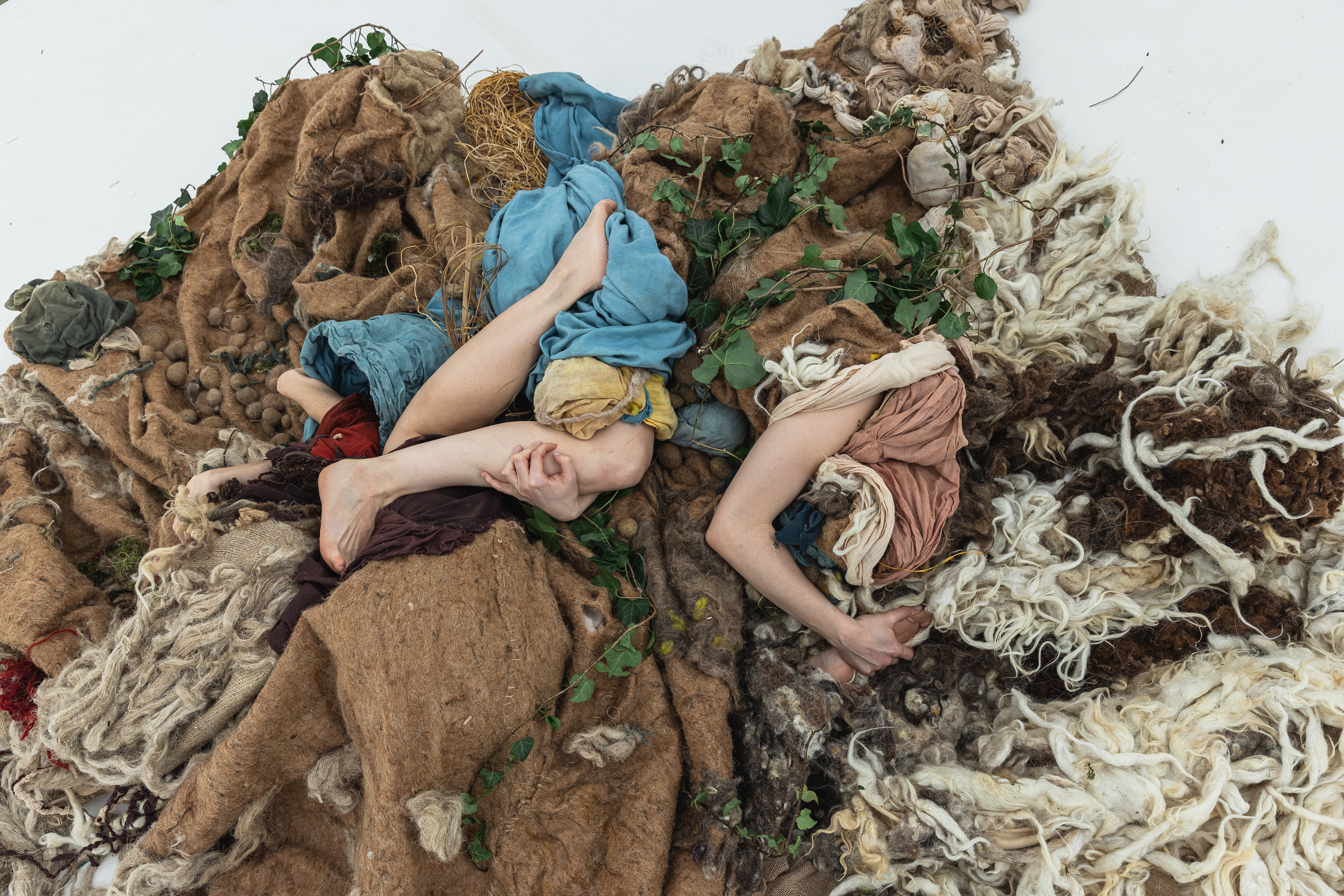
Image: Vanessa Grasse, Elysia. Photo: James Mulkeen
This October, Bioart Society hosts Microbial Lovesongs, an exhibition that coincides with the Centre for the Social Study of Microbes (CSSM) Conference 2026 at the University of Helsinki. Microbial Lovesongs brings together artists who have collaborated with CSSM over the past five years in experimental artistic residencies at the University, exploring what can come out of artists working with social scientists to develop methods for the social study of microbes, and to embody academic discussions from novel perspectives.
The exhibition features the work of artists Vanessa Grasse, Riina Hannula, Alma Heikkilä, Kirsty Hendry, Oona Leinovirtanen, Kaajal Modi and Aliisa Talja
Microbial Lovesongs extends the conference into the gallery to emphasise the art-science engagements without limiting the art to the structures of university space and its traditions, to expand possibilities of knowing with microbes. Rather than illustrating microbial science, the physical items and processes in the gallery space materialise it: installations you can lie down inside and listen to, sculptural forms shaped by fermentation, and pieces built from somatic practice and direct exposure to microbial worlds. These are less objects to observe than environments to feel and think with.
The exhibition treats knowledge-making itself as a sensory, embodied act — testing what art can know that text cannot, and what happens when social-scientific inquiry lets itself be shaped by processes as slow and unruly as fermentation, decay, and growth. Inspired by the leaky, transforming character of the holobiont (a human-microbial consortium), the works in SOLU Space are designed to entangle one another and morph throughout the conference. The exhibition itself performs the permeability it describes.
At its core, Microbial Lovesongs asks visitors to consider care, responsibility, and intimacy across species boundaries. The discomfort and tenderness of feeling, sensing, and digesting with our microbial companions is a position for knowledge production, a space opened by social scientific and artistic entanglements.
Opening times:
Bioart Society co-hosts the programme for registered participants during the conference on 19–22 October 2026.
Public visitors are welcome from 23–30 October, Friday–Friday: 12:00–17:00; closed Monday
Registration for the CSSM Conference 2026 is still open until October 5.
For more infomation on the artists' and to read their abstracts visit CSSM exhibition
Artist Bios
Aliisa Talja (she/they) is a multidisciplinary artist and facilitator who works with questions of relativity and diverse kinships of humans and more-than-humans, life-supporting ways of relating between them, as well as sensuous knowledges that enable them. Her individual work is artistic research, which takes the forms of texts, photographs, reflective exercises, and performance. In collaborations, she often develops events and participatory activities. Aliisa holds a Master of Arts degree in Contemporary Design from Aalto University, Helsinki, and is currently studying practical philosophy at the University of Helsinki.
Riina Hannula is a doctoral researcher living in rural South West Finland. Conducting their sociological research at the Center for the Social Study of Microbes (CSSM), they have also been able to draw on their background in art and experience in curating art-science collaborations. Hannula is a curator of the CSSM conference, convicted in developing possibilities for mutual knowledge production between art and social sciences. Working in a feminist science and technology (STS) domain, they are interested in meaning-making that intersects scientific and embodied perspectives. Their research objective is to understand embodied knowing of medical objects such as the vagus nerve and the gut-brain axis, and to make space for microbial agency within.
Kaajal Modi (she/they) is a multidisciplinary artist-researcher mediating material engagements with food, land and water to explore the politics of how humans relate to the world through our bodies, senses and imaginations. Kaajal’s practice is rooted in co-creation and embodiment, and incorporates listening, recording, remixing, moving, fermenting, foraging and gleaning to create lively and situated encounters between people, organisms and ecosystems. They are interested in the politics of migration and displacement as experienced through our relationship with the microbiosocial cultures with whom we share the world, as a way of both connecting to place materially, and as a metaphor for how we relate to others. Kaajal has a practice-based PhD in Art and Design from UWE, Bristol, and they currently lecture in Critical Digital Practices at the University of Leeds. Kaajal is part of the Sijelo Collective, a group of migrant womxn* artists, creatives and activists in the UK dedicated to addressing the intertwined challenges of displacement, racial justice, and climate justice.
Alma Heikkilä is an artist working with painting, installation and sculpture, graduated from the Finnish Academy of Fine Arts. Alma depicts things that are difficult to experience through the human sensorium. These include microbial life forms, forest ecosystems where important processes are located underground and inside plants, and large-scale phenomena that happen at a speed and scale beyond human comprehension. Heikkilä understands her artistic practice as a collaboration with other humans, materials and other phenomena. She is a founding member of Mustarinda. She has shown her work in solo exhibitions at Radius Delft, Melly Rotterdam, Grazer Kunstverein, Kiasma Helsinki, and elsewhere. She has taken part Biennials in Helsinki, Timișoara, Gwangju, Reykjavik, Vilnius and Fiskars. She was awarded the Marcus Collin Award 2024 and Ducat Prize in 2014. Her work is included in the collections of Kiasma, Finnish National Gallery, Malmö Art Museum, Busan Art museum, Emma Museum among others.
Kirsty Hendry (she/they) is an artist and facilitator based in Glasgow who develops projects exploring bodily knowledges and science fictions. Kirsty and their commensal collaborators work across writing, artist moving image, and other practices of metabolising information. Kirsty’s work is often collaborative, creating and developing methods of co-production to facilitate collective enquiry within community engagement and participatory contexts. This can include the general public through workshops and public programming; with a wide range of community groups; and with interdisciplinary groups of artists and/or professionals from music, science, performing arts, health & social care.Kirsty has undertaken residencies at The Centre for Contemporary Art (Glasgow), Hospitalfield House (Arbroath), and was Artist in Residence at CSSM (Helsinki) from March - September 2025. They are also the Learning & Engagement Programme Manager at Glasgow Sculpture Studios.
Oona Leinovirtanen is a multidisciplinary artist, and Oona Virtanen is a PhD student in sociology at the University of Turku, Finland. Currently, she works with sculpture, installation, weaving, and improvisation movement. In recent years, art and science have become intertwined in her work. The dissertation examines microbial gardening practices in a permaculture garden, as well as the material and metabolic relationship between the human body and the garden. She is interested in our bodily relationship with nonhumans, which she ponders in the garden, where weeds now outnumber human food. Luckily, weeds are good for weaving. She enjoys living outdoors and moving less upright and more in all other positions. She is a member of the art collective Earth Forces (Maanpuolustusvoimat) and has been a member of CSSM from its starting.
Vanessa Grasse is a multidisciplinary artist, choreographer, performer, facilitator, somatic coach and curator from Italy and the UK, and the current artist-in-residence at the Centre for the Social Study of Microbes (CSSM). She works at the intersection of choreography, somatics, sculpture, walking art and Land Art, creating work that connects us to our landscapes, ecosystems and communities. Her practice is grounded in embodiment and often takes the form of site-responsive and participatory performances, workshops, collaborations and research, working across different forms and media and collaborating across disciplines to explore relational and ecological ways of being and our entanglement with human and more-than-human life. She trained as a contemporary dancer and holds an MA in Creative Practice Dance from Trinity Laban Conservatoire of Music and Dance in London. She is a certified Relational Dynamics Coach, Somatic Stress Release™ practitioner, yoga and Qigong facilitator, and embeds these practices into her creative work.